
John 1:19-34
Focus verse: ‘Then John gave this testimony, “I saw the Spirit came down from heaven as a dove and remain on him.”’ (John 1:32)
Old Testament lens: ‘Do not break any of the bones.’ (Exodus 12:46)
John the Baptist came saying, ‘Look, the Lamb of God who takes away the sin of the world!’ (John 1:29) This statement is rich in meaning and connects deeply with the story of the Passover in the Old Testament. In Exodus 12:46, God gave specific instructions for the Passover lamb: it had to be perfect and none of its bones could be broken.(1) This lamb was sacrificed so that God’s judgment would ‘pass over’ the households marked with its blood. That lamb was a symbol pointing forward to Jesus.
Fast forward to the crucifixion of Jesus. John’s Gospel tells us that Jesus died on the day of preparation for the Passover (John 19:14), the very day when lambs were being sacrificed in the Temple. When the soldiers came to break the legs of the crucified men to speed up their deaths, they found that Jesus was already dead, so they didn’t break His legs (John 19:32–36). John emphasises this detail to show that Jesus perfectly fulfilled the role of the Passover lamb: not a single bone was broken, just as Scripture foretold (Psalm 34:20, Exodus 12:46). God orchestrated every detail to show us that Jesus is the true Passover lamb — the one whose sacrifice brings forgiveness of sins and protection from judgment.
But Jesus is not just the Lamb; He is also the Lamp. In Revelation 21:23, we get a glimpse of the New Jerusalem, the eternal city where God will dwell with His people. ‘The city does not need the sun or the moon to shine on it, for the glory of God gives it light, and the Lamb is its lamp.’ There is no darkness, no night, and no need for other sources of light because the Lamb Himself shines. Jesus’ physical bones were not broken on the cross but His will was broken.
The Early Church Fathers who inspired the Celtic Church
St Gregory of Nazianzus (329–390), one of the Cappadocian Fathers, Archbishop of Constantinople (capital of the Eastern Roman Empire)
‘Let us become like Christ, since Christ became like us.’ (2)
Gregory came from a deeply Christian family in Cappadocia; his father was Bishop of Nazianzus. He had an excellent classical education (Caesarea, Alexandria, Athens) and was skilled in rhetoric. Though he became a bishop (for a time in Constantinople), he always had a strong ascetic and contemplative lean in his spirituality. His writings — especially his orations — addressed major theological issues such as the Trinity. St Gregory of Nazianzus calls John the Baptist the ‘voice of the Word’, emphasising that John diminished himself completely so that Christ’s glory could be heard: ‘He was the voice, but the Word was God … John was the lamp, but the light was the true Light.’
Gregory uses John the Baptist as a theological and spiritual paradigm: humility, preparation, transformation, pointing to Christ. Gregory uses John as a model for all Christians who wish to ‘decrease’ so Christ may ‘increase’. The Celtic Church’s spirituality (monasticism, asceticism, emphasis on interior transformation, veneration of John the Baptist) shares many of the same motifs.
The Celtic Church continued a strong veneration of John the Baptist (as is common in the East). The respect for the ‘forerunner saint meshes with Gregory’s teaching: John as the herald of Christ, as one who diminishes for Christ. This metaphor was deeply influential. The lamp imagery inspired many Eastern Fathers to interpret sanctity as the extinction of the self so that divine light might shine through.
In a later tradition, it was said that a dove landed on the shoulder of the Celtic saint, St David (3) (c500–589) while he preached at the Synod of Brefi, and the ground rose beneath him so all could hear his voice. This miraculous event was interpreted as a sign of divine approval and Spirit-anointing, much like the dove resting on Jesus at his baptism. The dove became a symbol often associated with David in Welsh iconography, showing the lasting impression of that image. This connection mattered because the Holy Spirit, in the form of a dove confirming David’s authority, mirrors the baptismal scene and God’s voice and Spirit affirming Jesus. David was being affirmed as a spiritual leader in a similar way.
REVIVAL
Roy Hession says ‘in order to break our wills to his, God brings us to the foot of the cross, and there shows us what real brokenness is. We see those wounded hands and feet, that face of love, crowned with thorns, and we see the complete brokenness of Jesus. So, the way to be broken is to look on him, and to realise it was our sin which nailed him there; then, as we see the love and brokenness of the God, who died at our place, our hearts will become strangely melted, and we will want to be broken for him.’(4)
We also read how the Holy Spirit came upon Jesus at his baptism by John. Hession says, ‘What a suggestive picture we have here, the dove descending upon the lamb, and resting upon him! … The lamb speaks of meekness and submissiveness, and the dove speaks of peace. The main lesson of this incident is that the Holy Spirit as the dove could come upon and remain upon the Lord Jesus, only because he was the lamb … The dove can abide upon us, only as we are willing to be as the Lamb. How impossible that he should rest upon us, while self is unbroken! The manifestations of the unbroken self are the direct opposite of the gentleness of the dove. Read again the ninefold fruit of the Spirit (love, joy, peace, long-suffering, gentleness, goodness, faithfulness, meekness, self-control) in Galatians 5, with which the dove longs to fill us.’(5) Humility, which is the central monastic virtue, begins in the fear of the Lord, which simply means acknowledging the divine omnipresence and acting accordingly. Columba Stewart says that ‘awareness of the presence of God, humility, the central monastic virtue, begins in “the fear of the Lord.”’(6)
Idols are those things we go to for comfort before we go to the Lord. We have the fear of the Lord on us to the degree that we are free from idolatry.
PRAYER
Jesus, Lamb of God, who takes away the sin of the world, show me the areas of self in me that are as yet unbroken. Shine Your light on me. Show me those idols in my life … those things I go to for comfort before I go to You, Lord. Lord, You are the Lamb who is the lamp forever bright … guiding us home … into Your light. Show me those idols in my life.
THE LAMB IS THE LAMP ( Click on the picture below to listen to song)
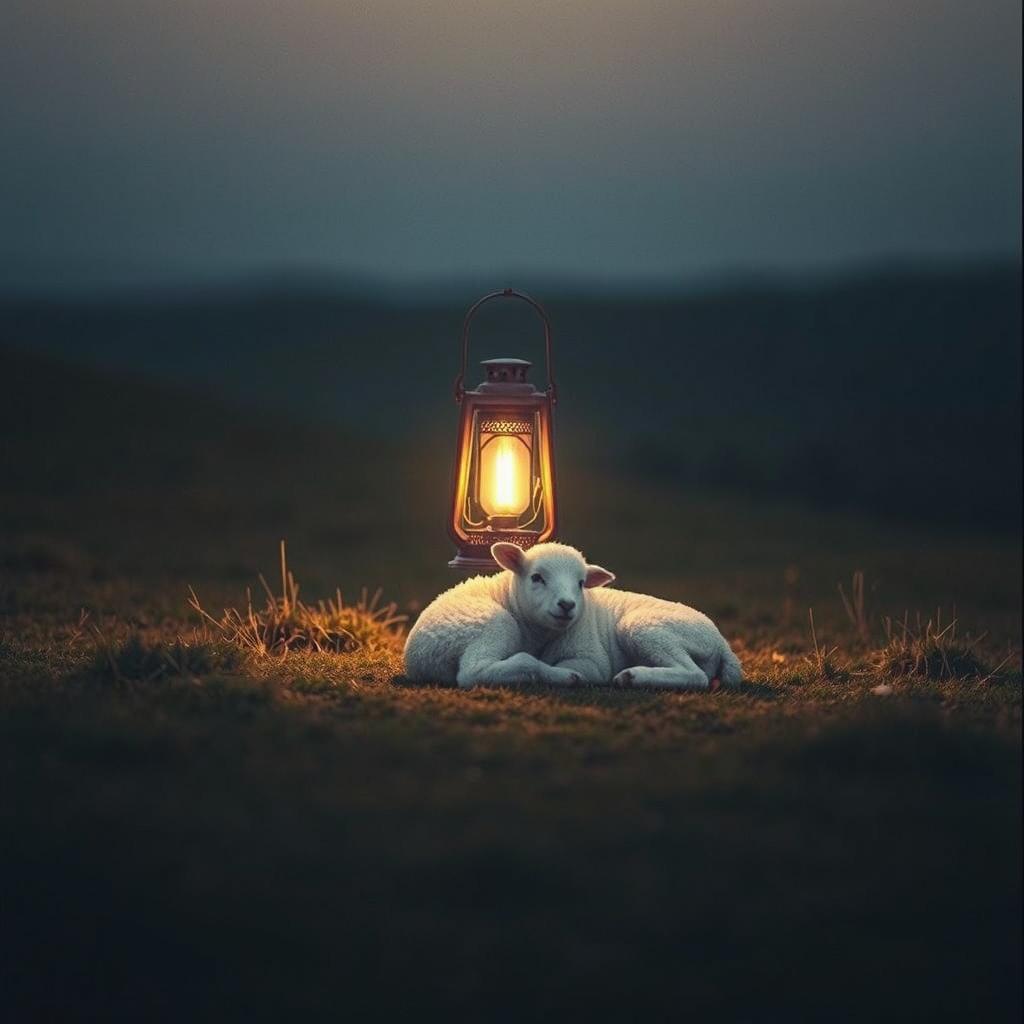
___________________
(1) Hays, R. Echoes of Scripture in the Gospels, Baylor University Press (2018) ,286
(2) St Gregory of Nazianus, Oration 1 ( On the Son) in Browne, C. Five Theological Orations (1995)
(3) history.glastonburyshrine.co.uk+stadavidscathedral.org.uk+3rcstortford.org.uk+3
(4) Hession, R. The Calvary road, Rickford Hill (2003), 19, 20.
(5) Hession, R. The Calvary Road, Rickford Hill (2003), 26.

 UNBLOCKING THE WELL OF THE LIVING WORD
Leave a comment