
John 7:1–31
Focus verse: ‘Not until halfway through the festival did Jesus go up to the temple courts and begin to teach.’ (John 7:14)
Old Testament lens: ‘Live in temporary shelters for seven days.’ (Leviticus 23:42–43)
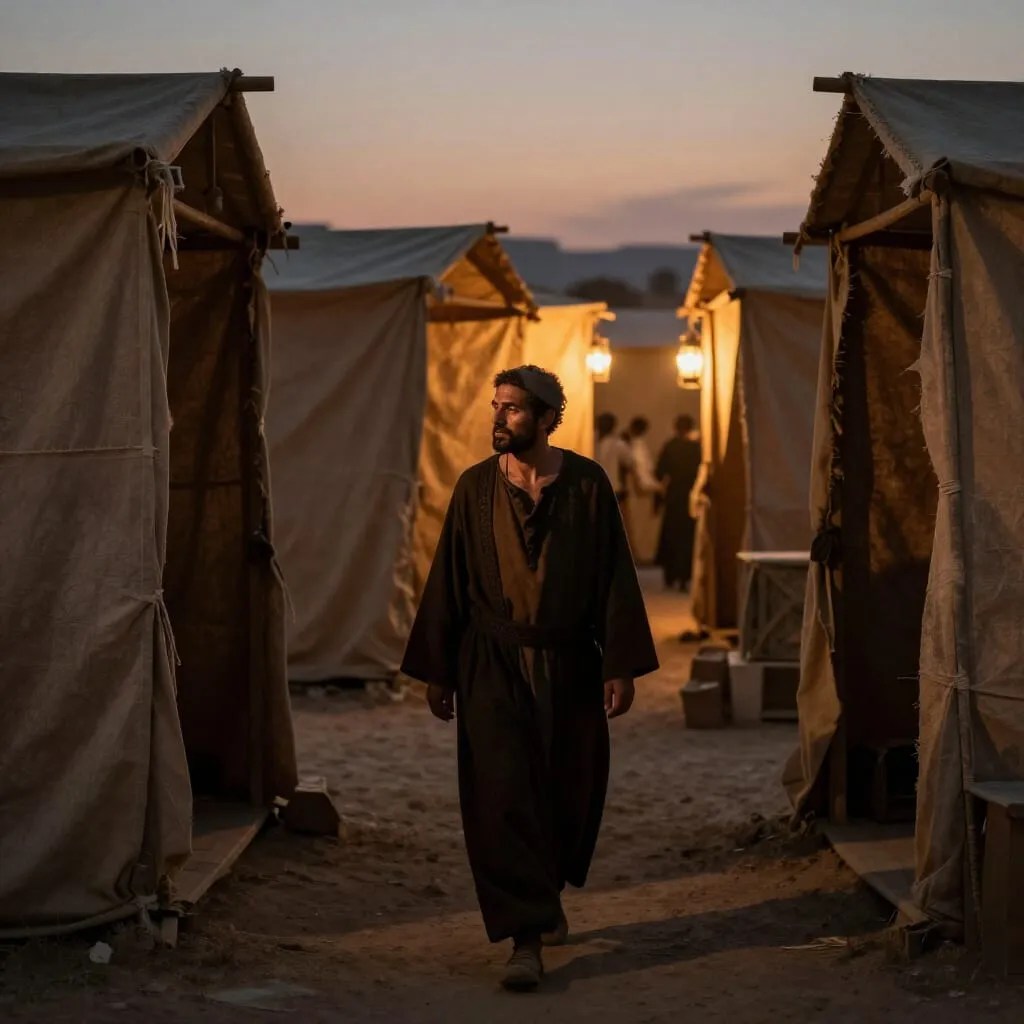
John 7 opens with Jesus in Galilee at the Feast of Tabernacles (also called the Feast of Booths). This was one of the most important festivals in the Jewish calendar. Jesus had avoided going to Judea because of rising threats against His life. Jesus’ brothers had encouraged Him to go to the feast publicly to show His miracles, but John notes that even His own brothers didn’t yet believe in Him. Jesus responds that His time has not yet come, hinting at His divine mission and the unfolding of God’s perfect timing.
When Jesus does eventually go to Jerusalem for the feast, He goes quietly, not seeking public attention. But around the middle of the festival, He begins teaching openly in the Temple, sparking both amazement and debate. It is at this point that some people begin to ask: could this be the Messiah?
To understand why Jesus’ presence at this particular festival is so significant, we need to grasp the meaning of the Feast of Tabernacles. Rooted in Leviticus 23:33–43, it commemorates Israel’s journey through the wilderness after the Exodus. During the feast, people lived in temporary shelters (booths) to remember how God provided for them during those years of wandering. It was both a historical remembrance and a celebration of God’s faithfulness. Over time, the feast also took on messianic expectations — it pointed forward to a future time when God would once again dwell with His people and fulfil His promises.
Two key symbols of the Feast of Tabernacles, water and light, play a central role in John’s Gospel. In the chapters following, Jesus speaks of living water (John 7:37–39) and declares, ‘I am the light of the world’ (John 8:12). These aren’t random metaphors, they’re deeply connected to the rituals of the festival. Each day of the feast involved water ceremonies, reminding people of God providing water from the rock in the wilderness. There were also night-time celebrations with great lamps lit in the Temple, symbolising God’s presence and guidance.
Jesus was fulfilling the festival of the Feast of Tabernacles, which connects to the broader biblical story. Zechariah 14 looks ahead to a future ‘day of the Lord’, when God will reign as King, living water will flow out of Jerusalem, and all nations will gather to worship and keep the Feast of Tabernacles. In that prophetic vision, the festival becomes a symbol of global worship and God’s final victory. So when Jesus steps into the Temple during this festival, He is standing at the crossroads of Israel’s past, present, and future. Jesus uses the Feast of Tabernacles, to reveal that He is the true presence of God dwelling with His people. The festival, with all its symbols, finds its deepest meaning in Him.
The Early Church Fathers who inspired the Celtic Church
St Jerome (347–420), Dalmatia, Bethlehem, translator of the Latin Vulgate, key for scriptural study
‘Ignorance of Scripture is ignorance of Christ.’ (1)
This is St Jerome’s most famous saying, quoted throughout Christian history. Jerome’s most famous achievement is the Latin Vulgate, the definitive Latin translation of the Bible for the Western Church. He translated the Old Testament directly from Hebrew (rather than the Greek Septuagint, which was common before him). He revised the Old and New Testaments to produce a coherent, standard Latin text. The Vulgate became the authorised Bible of the Roman Catholic Church for over a thousand years, shaping Western Christianity, theology, and liturgy. Jerome’s biblical scholarship gave the Celtic Church a vital textual foundation (the Vulgate), inspired their monastic scholarship and manuscript culture, and helped connect their unique spiritual practices to the broader Christian world.
Jerome withdrew from city life to pursue a stricter, ascetic form of Christianity and around 373, he went into the Syrian desert. The hermit lifestyle of Jerome and the Celtic saints was focused ultimately on encountering God and being transfigured into glory. Here in John 7:18 Jesus said, ‘Whoever speaks on their own does so to gain personal glory, but he who seeks the glory of the one who sent him is a man of truth; there is nothing false about him.’ Jerome, as he withdrew into the desert, was focused not on gaining personal glory but on being a man of truth who was seeking Jesus’ glory.
REVIVAL
Zechariah 14:16–19 prophesies that the nations that survive God’s judgments are required to come up to Jerusalem every year to worship the King, the Lord of hosts, and to keep the Feast of Tabernacles. This will confirm that the Feast of Tabernacles will become a global observance in the age to come. It symbolises unity, peace, and divine presence under the Messiah’s reign. Failure to observe it brings judgment (symbolised by drought) — showing its continued covenant importance.
As we pray for revival, it is time to pray for ‘the fountains of the great deep to burst forth’. This is a phrase used in Genesis 7, regarding a natural flood of water that covered the globe. We are getting closer to the end times that are prophesied in Habakkuk 2:14: ‘For the earth will be filled with the knowledge of the glory of the Lord as the waters cover the sea.’ In Isaiah 11:9 there is a very similar verse and also in Numbers 14:21 and Psalm 72:19. As we pray not for a flood of water but for a flood of the knowledge of the glory of the Lord to cover the earth as the waters cover the sea, let’s declare Psalm 29:10: ‘The Lord sits enthroned over the flood; the Lord is enthroned as King forever.’
At the Feast of Tabernacles, Jesus reveals that He is the true presence of God dwelling with His people. The two key symbols of the Feast of Tabernacles (water and light) play a key role in John’s Gospel, symbols of Word and Spirit. Smith Wigglesworth gave a prophecy in 1947: ‘When the Word and Spirit come together, that will mark the beginning of a revival that will eclipse anything that has been witnessed within these shores, even the Wesley and the Welsh revivals of former years.’
PRAYER
Lord, we remind You of the promise that You will flood the earth as the waters cover the sea. Lord, You sit enthroned over the flood of glory; may Your authoritative word be released. ‘Unblock the well of your Word and your Spirit, we pray. May the fountains of the great deep burst forth and the glory of the Lord cover the earth as the waters cover the sea.’
He walked to the feast in the shadows ( CLICK ON PICTURE TO LISTEN TO SONG)
______________________
(1) Jerome, Commentary on Isaiah, ( Prologue, Book 1), Paulist press, 2015.

 UNBLOCKING THE WELL OF THE LIVING WORD
Leave a comment