
John 7:32–53
Focus verse: ‘As the Scripture said, out of his belly shall flow rivers of living water.’ (John 7:37–39)
Old Testament lens: ‘On that day living waters shall flow out from Jerusalem.’ (Zechariah 14:7–8)
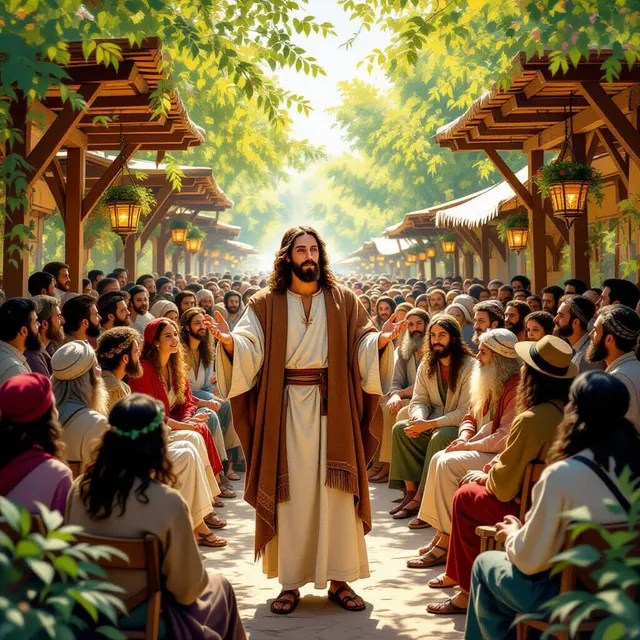
In John 7:37–39, Jesus stands up on the last and greatest day of the Feast of Tabernacles (Sukkot) and cries out, ‘Let anyone who is thirsty come to me, and let the one who believes in me drink. As the Scripture has said, “Out of his belly shall flow rivers of living water.”’ This is Richard Hays’ translation, (1) and it differs from most English versions. Many Bibles interpret the rivers of living water as flowing from the believer, but Hays argues that these waters flow from Jesus Himself.
This insight significantly reshapes our understanding of the passage. Rather than suggesting believers become fountains of living water, the focus is squarely on Jesus as the source. According to Hays, Jesus is identifying Himself with the eschatological promises in Ezekiel 47 and Zechariah 14, key Old Testament passages traditionally read during the Feast of Tabernacles.
In Ezekiel 47, the prophet sees water flowing from beneath the restored Temple in Jerusalem, bringing life and healing wherever it goes. Similarly, Zechariah 14 speaks of a future day when living waters will flow out from Jerusalem. Jesus, standing during Sukkot, with its rituals of water and light, claims to be the new Temple, the true source of living water. The water rituals of the festival, which involved pouring water at the altar, to remember God’s provision and to hope for future rain, now find their fulfilment in Christ.
Hays emphasises that Jesus is replacing the symbols with His own person. Just as the festival lights symbolised God’s presence and glory, Jesus says in John 8:12, ‘I am the light of the world.’ Just as water symbolised future renewal, Jesus offers living water — His very self and the Holy Spirit (v39). Hays’ reading challenges us to see Jesus as the Temple, the one from whom life flows. This has powerful implications for how we relate to Jesus. We don’t just receive from Him; we come to Him. He is the source. Like the Samaritan woman in John 4, we are called to come and drink from Jesus, the well that never runs dry.
The Early Church Fathers who inspired the Celtic Church
Clement of Alexandria (c150–215), part of the Alexandrian school
‘The way of truth is one, but into it, as into a perennial river, streams flow from all sides.’ (2)
This most famous of Clement’s sayings is often quoted to express his Christian humanism and integration of reason and faith. The Alexandrian school emphasised allegorical interpretation of Scripture and the pursuit of spiritual knowledge within orthodox Christian bounds. These ideas influenced major figures like Origen and resulted in the transmission of Alexandrian thought into Western monasticism.
Clement of Alexandria read Scripture as: ‘inspired and unified revelation from God, multi-layered, with literal, moral, and spiritual meanings, philosophically rich, harmonising revelation and reason, Christ-centred, with the Logos as the interpretive key, transformative, aiming at the believer’s growth into true knowledge (gnosis) and holiness’. Effectively, he read Scripture as a ‘river of life’. Partly as a result of Clement of Alexandria, the Celtic Church had a symbolic and poetic approach to theology and Scripture.
For St Patrick, springs and wells played overt roles. He is credited w ith the miracle of a spring (fountain) miraculously coming from beneath a rock at Elphin (‘the rock of the clear stream’). The spring that Patrick caused mirrors biblical ‘water from the rock’ (which is also part of the background biblically for the ‘living water’ imagery).
Wells were used for baptism, healing, meeting daily needs, and spiritual and physical sustenance. This corresponds with the use of thirst, belief, and inner flow in John 7. Celtic Christianity has thousands of holy wells: natural springs, wells and sacred water sources associated with saints. Many churches are built near wells — wells used for baptism, springs said to burst forth miraculously.
The metaphor of water, thirst, springs, wells, flowing or fountain water is deeply embedded in Celtic saintly tradition. Many saints acted out aspects of that metaphor, they became sources of healing (wells), they lived in austerity, drinking only water or using water in penitential practices, they found springs or promoted them. Spiritually, these stories show a longing for purity, spiritual refreshment, and renewal, roughly analogous to ‘thirsting for God’ and receiving ‘living water’ (ie the Spirit) as in John 7.
REVIVAL
Do you have a longing to ‘read the Bible with God’s heart’ and to ‘pray with God’s heart’? Do you have a longing for a river of life to flow out of you, and for personal and national revival? That river will come as you call out to the Lord with a level of desperation you have not known yet.
Corey Russell says that we need tears, travail and tongues as we intercede for revival. He tells the story of Frank Bartleman in the wake of the death of his daughter Esther, ‘praying in’ the Azusa Street Pentecostal outpouring on 14 April 1906. Russell, in his book The Gift of Tears, reminds us of Father Nash, who travailed in prayer and tears alongside Charles Finney in the Second Great Awakening, and Peggy and Christine Smith, who cried out to the Lord for the youth on the Isle of Lewis before the Hebrides Revival associated with Duncan Campbell. He says, ‘I believe that there will be many storylines that bring God’s people to a place of desperation for him to move in our generation. The primary purpose of God is bringing you to that point. He is bringing you to the place where you will shed tears, tears of revival. He’s bringing you past the place of words to release tongues for revival. He is bringing you to the altar where you will labour with him, where you will travail for revival. It is time to unblock a well of tears of revival.’
We need to read the Bible with God’s heart as a river of life like Clement of Alexandria. We also need to pray with God’s heart … and what are the hallmarks of revival? In the book of Acts there are ten hallmarks of revival: 1 ‘Divine visitation’, sovereign, sudden and supernatural; 2 ‘Anointed preaching’, courageous and confrontational preaching; 3 ‘Radical conviction’; 4 ‘Passionate intercession’; 5 ‘Evangelistic worship’; 6 ‘Miraculous works’; 7 ‘Kingdom community’; 8 ‘Social transformation’; 9 ‘Sacramental reality’; 10 ‘Constant conversions’.(3)
PRAYER
Lord, You are my God, earnestly I seek You. I thirst for You, my whole being longs for You, in a dry and parched land where there is no water. I come to You. You are the Temple, torn and raised, You are the glory, light and flame! You are the water, You are the rain! The Spirit comes in Jesus’ name! Come and drink! Come and drink! You are the river, deep and wide, I come to You and drink.
Come and drink ( CLICK ON PICTURE BELOW TO LISTEN TO SONG)
________________________
(1) Hays, E. Echoes of Scripture in the Gospels, Baylor University Press, (2017), 315.
(2) Clement of Alexandria, Stomata ( Miscellanies), Beloved Publishing (2014)
(3) Stibbe, M. Revival, Monarch books ( 1998) 107-122.

 UNBLOCKING THE WELL OF THE LIVING WORD
Leave a comment