
John 10:1–31
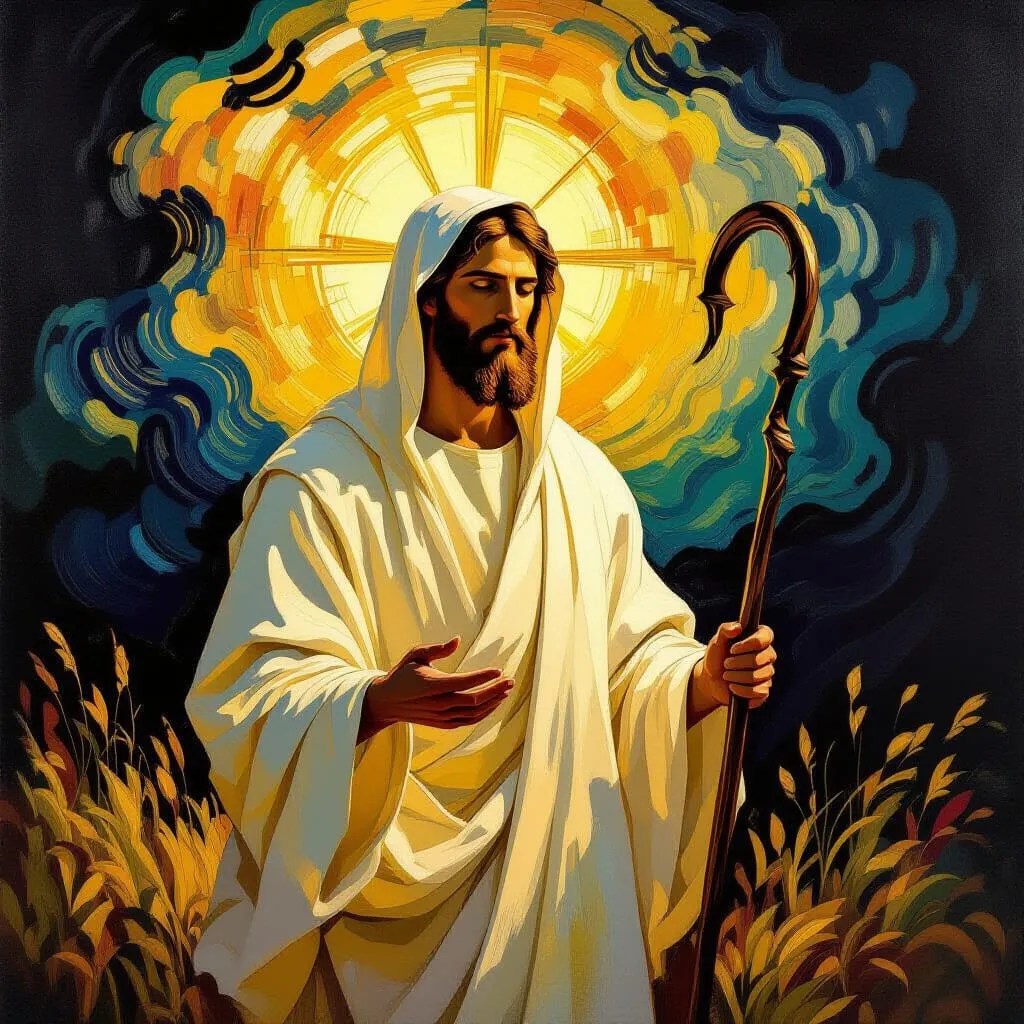
Focus verse: ‘I am the Good Shepherd.’ (John 10:11)
Old Testament lens: ‘I myself will be shepherd of my sheep, says the Lord God.’ (Ezekiel 34:23–24)
In the biblical imagination, few images are more powerful or enduring than that of the shepherd with his sheep. This is a metaphor for kingship, not the boardroom strategist or military general, but the tender, watchful shepherd. Ezekiel (1) had voiced God’s promise: ‘I will set up over them one shepherd, my servant David … and he shall be their shepherd’ (Ezekiel 34:23–24).(2) In the same breath, God declares, ‘I myself will be shepherd of my sheep’ (v15).
This paradox, God will shepherd and yet David will shepherd, hangs unresolved until Jesus steps into view. In John 10, Jesus speaks into this prophetic frame, offering a layered, controversial, and ultimately breath-taking claim. He begins not with a direct declaration, but with a parable (vv1– 5), contrasting the true shepherd with thieves and strangers. These images echo Ezekiel’s scathing rebuke of Israel’s failed leaders. The ‘thieves and brigands’ are likely Jesus’ own contemporary leaders, some collaborating with Rome, others stirring up violent revolt.
Jesus is asking, in effect: ‘How will you recognise God’s true king when He comes?’ The answer: the true shepherd enters by the proper gate; He is recognised by His sheep. His legitimacy is confirmed not by force, but by intimate knowledge and trust. Jesus says, ‘I am the door of the sheep … whoever enters by me will be saved’ (vv7–9). Then he says in verse 11: ‘I am the Good Shepherd. The Good Shepherd lays down his life for the sheep.’ When the crowd presses Jesus, ‘If you are the Messiah, tell us plainly!’ Jesus’ response is cryptic yet weighty. He points to His works, healing, feeding, restoring.
These are the very acts Ezekiel had said God Himself would do as Shepherd: ‘I will seek the lost, I will bind up the injured, I will feed them with justice’ (Ezekiel 34:16). Jesus says a most astonishing line: ‘I and the Father are one.’ Jesus is both God come to rescue His sheep and the Davidic king they longed for.
The Early Church Fathers who inspired the Celtic Church
St Hippolytus of Rome (c170–235), ‘A faithful shepherd’
‘Grant that your servant, whom you have chosen for oversight, should shepherd the flock and should serve before you as high priest without blame, serving night and day, ceaselessly making your face favourable and offering the gifts of your holy Church.’ (3) (Ordination prayer)
Hippolytus was an early Roman theologian and likely a presbyter in the Church of Rome. He was a prolific writer, especially on theology, biblical commentary, Church order, and heresies. He was sometimes considered the first ‘antipope’, having been elected by a faction opposed to the bishop of Rome (Pope Callixtus I), but later reconciled with the Church. He was martyred around 235 during the persecution under Emperor Maximinus Thrax. He was deeply concerned with moral and doctrinal purity. He opposed the laxity in Church discipline under Pope Callixtus I. He reconciled with the Roman Church before his death, a powerful witness of humility and Church unity.
Hippolytus is linked to the ‘Good Shepherd’ motif, a common image in early Christian art. The Celtic Church was rich in symbolic and visual spirituality, using nature, animal, and pastoral imagery to express theological truths. The idea of Hippolytus as a faithful shepherd willing to suffer for his flock could have inspired Celtic Christians, who often saw their saints as spiritual shepherds of wild, remote communities.
St Cuthbert of Lindisfarne (c634–687) is one of the most vivid examples of a shepherd-like leader in the early Celtic Christian tradition. His life beautifully mirrors the image of Christ as the Good Shepherd, not only through literal acts of care but in his spiritual leadership, humility, and self-giving love. Cuthbert’s entire ministry was marked by deep pastoral care: as a monk, prior, and later bishop of Lindisfarne, he didn’t just administrate — he personally journeyed to remote villages, even during harsh weather, to preach, teach, anoint the sick, and offer comfort. His missionary journeys, especially by foot or boat across rugged Northumbrian landscapes, echo the Good Shepherd’s willingness to go out and find the lost sheep. ‘He often did what few others would: walk long distances to minister to the poor and isolated. He did not consider status, only souls,’ said the Venerable Bede.
Cuthbert’s kindness extended beyond people to the natural world, a key feature of Celtic Christian spirituality. A famous story tells of Cuthbert praying all night in the cold North Sea. When he came ashore, two otters came and warmed his feet with their breath and fur. He blessed them in return. He protected nesting birds on the Farne Islands, forbidding unnecessary harm to wildlife. To this day, those islands are a bird sanctuary.
These stories reflect a shepherd’s gentleness and resonate with Celtic ideas of a deep harmony between the spiritual and natural world. In his later life, Cuthbert chose the life of a hermit on Inner Farne Island: he lived in solitude, devoting himself to prayer, fasting, and contemplation, much like the image in John 15 of abiding in the vine (Christ). His time alone was not for escape but for deepening his connection with God, allowing his soul to be ‘pruned’ and shaped. Even in solitude, people sought him out for wisdom and prayer — his reputation for holiness made him a spiritual beacon.
Like Christ who ‘lays down his life’ (John 10:11), Cuthbert obeyed reluctantly but faithfully when he was called to become bishop of Lindisfarne: he initially refused the role, preferring his quiet life, but eventually submitted out of love for the Church and his community. His leadership was marked by humility, service, and a desire to lead by example, not command. As he neared death, Cuthbert chose to return to his island hermitage, trusting his fellow monks to continue the work of shepherding the flock.
REVIVAL
Barbara Yoder says that in the Bible ‘gates’ are places of decision. The Lord Jesus Christ is our gate. Yoder says, ‘all of us need a new anointing to slip through narrow places, that constrict and restrict our forward progress. In order to escape pursuers at a “greased pig” County Fair event, competitors try to capture a live pig that has been greased. We need to be like that, smeared with the oil of God’s anointing.’ (4) The Lord Jesus Christ is our Shepherd, at this narrow gate that we are passing through at such a time as this in world history.
PRAYER
Lord, grease us up like greased pigs to pass through the gate. Isaiah said, ‘Pass through, pass through the gates, prepare the way for the people. Build up, build up the highway, remove the stones and raise a banner for the nations.’ (Isaiah 66:10) Show us the stones that are hindering us. Pass through this time of transition into revival. Lord, at the place of warfare at the threshold, at this gate of transition my nation is passing through, I declare the gates of hell will not prevail. You are the only one who can break through the seemingly impenetrable barriers in my life and my nation’s life. I line up with You, Lord Jesus Christ, ‘The breaker through’.
________________
(1) Wright, N.T. John for Everyone, Part 1 , SPCK, 148, 149.
(2) Hays, R. Echoes of the Scripture in the Gospels, Baylor University Press, (2017), 319.
(3) Hippolytus of Rome Apostolic Tradition (Ch 3, p4-5- an ordination prayer) St Vladimir’s Seminary Press, (2011)
(4) Yoder, B. The Breaker Anointing Chosen books, (2017)

 UNBLOCKING THE WELL OF THE LIVING WORD
Leave a comment