
John 12:9–50
Focus verse: ‘Hosanna, blessed is he who comes in the name of the Lord; blessed is the king of Israel.’ (John 12:13)
Old Testament lens: ‘See your king comes to you, righteous and victorious, lowly riding on the donkey.’ (Zechariah 9:9)
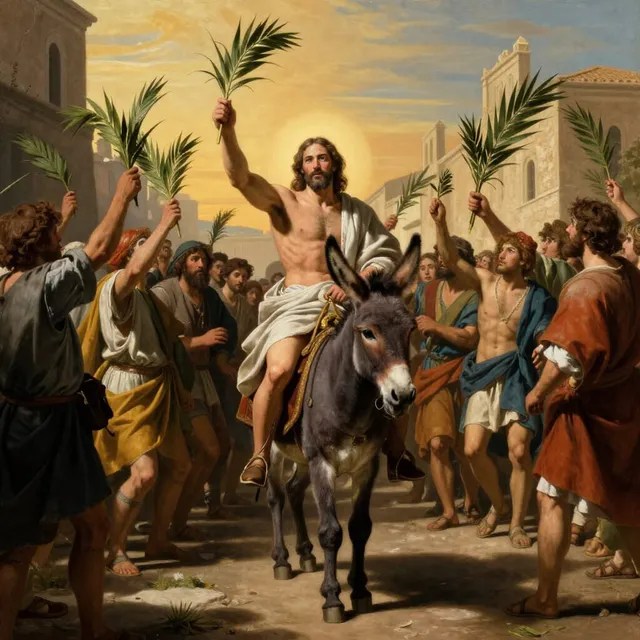
When Jesus entered Jerusalem riding on a donkey (John 12:12–19), it wasn’t just a random moment of excitement. This event is a key time where everything comes together (1)— Passover, Hanukkah, prophecy, and the question of who Jesus truly is. Passover was a time to remember how God used the blood of a lamb to save His people, leading them through the Red Sea and into freedom. For Jesus to enter Jerusalem during Passover already suggested something significant, especially when we remember that John has already called Jesus ‘the Lamb of God’.
But there’s more going on. The people waving palm branches were actually using symbols from a different Jewish festival, Hanukkah. This feast celebrated when Judas Maccabeus led a revolt against pagan oppressors and reclaimed the temple in 164BC. His victory marked the beginning of a new kingship, and people welcomed him with palm branches as a hero and deliverer. So when Jesus’ followers waved palm branches and shouted, ‘Blessed is he who comes in the name of the Lord, King of Israel!’ (John 12:13), they were blending the symbols of both Passover and Hanukkah.
John connects this event directly to Old Testament prophecy, especially Psalm 118 and Zechariah 9:9.(2) Zechariah had foretold that Israel’s king would come riding on a donkey, a peaceful king, not a military conqueror. Jesus is fulfilling this exact vision. Psalm 118, often sung at Passover, blesses ‘the one who comes in the name of the Lord’. Jesus is now identified with that very promise. Just after the Pharisees complain that ‘the whole world has gone after him’ (John 12:19), foreigners (from Greece) come asking to see Jesus. This shows that Jesus didn’t just come for Israel, but for the whole world, to draw all people to Himself (John 12:32).
Ultimately, John wants us to see Jesus as the true King who fulfils the Scriptures, reshapes Jewish hopes, and brings salvation to all. His entry into Jerusalem is a signal that God’s promises are being fulfilled in a new and unexpected way. As we watch Jesus ride into Jerusalem, we are invited to see Him as the humble King who brings true freedom, not through force, but through love and sacrifice. As Tom Wright reminds us in his book How God Became King (3)the fundamental problem deep at the heart of the Christian faith is that we have all forgotten what the Gospels are about.
The Early Church Fathers who inspired the Celtic Church
Cyril of Jerusalem (c313–386), a 4th-century bishop and Church Father
‘Take heed that thou fall not away from the grace as thou goest thy way; for the road is long, and the end is great.’ (4)
Cyril is best known for his Catechetical Lectures. A strong feature of his teachings is the idea of a sacred journey through life, emphasised in Cyril’s catechesis. This harmonised with the Celtic Church’s metaphor of life as a pilgrimage or peregrinatio pro Christo (wandering for Christ). The teachings are set in the context of Jerusalem. While the Celtic Church was far from Jerusalem, it developed a strong idea of ‘spiritual pilgrimage’.
The lives and legacies of the early Celtic and Anglo-Saxon saints, Cuthbert, Kevin, David, Columba, and Ita, together with the historic Synod of Whitby, reveal a transformative period, a pilgrimage or journey of British Christianity marked by humility, service, and the reconciliation of differing traditions.
St Cuthbert of Lindisfarne epitomised the virtue of humble leadership, service over status. Despite being elected bishop, he initially fled to avoid the position, preferring the solitude of prayer and manual labour. When he finally accepted, he remained humble and industrious, engaging in physical work such as digging trenches, repairing buildings, and caring for the sick. His actions showed that leadership in the Church meant service, not privilege.
Similarly, St Kevin of Glendalough embodied compassion over comfort. The famous story of Kevin praying motionless with outstretched arms so as not to disturb a nesting bird symbolises profound humility and reverence for creation, an expression of care that transcended self-interest and physical suffering.
St David of Wales (5) emphasised faithfulness over fame. His final counsel to his followers, ‘Be joyful, keep the faith, and do the little things that you have seen me do’, encapsulated his belief in holiness through small, consistent acts of devotion rather than grand gestures. His message endures as a national Welsh motto, celebrating humility and constancy.
St Columba’s life represents repentance over pride. Early in his life, his actions indirectly caused bloodshed, leading him to deep remorse. In atonement, he left Ireland for exile on Iona, where he devoted his life to prayer, peace, and missionary work, spreading Christianity throughout Scotland.
St Ita of Killeedy, often called ‘the foster mother of the saints of Ireland’, reflected simplicity over self-promotion. Her humility was expressed not through withdrawal from the world, but through faithful presence and nurturing guidance within it.
The Synod of Whitby (AD664) stands as a pivotal moment in uniting the diverse Christian traditions of the British Isles. Convened by King Oswiu of Northumbria at Hilda’s monastery, the synod sought to resolve disputes over the calculation of Easter. Bishop Colman, representing the Celtic tradition from Iona, argued for the practice handed down from St John, while Wilfrid defended the Roman custom, emphasising its universality across Christendom. When Oswiu asked whether St Peter had been given the ‘keys of the kingdom of heaven’, and Colman admitted that he had, the king declared he would follow Peter’s authority, ‘lest when I come to heaven’s gate, there be none to open it for me.’ His decision established Roman practice in Northumbria and marked a significant step toward ecclesiastical unity under Roman influence. The Synod of Whitby was the beginning of the end of Celtic Christianity.
REVIVAL
We live in day when there are signs of life with talk of a ‘quiet revival’, since the Bible Society’s report and evidence of more young men attending church.(6) At the same time, there is news of a potential split of the Anglican Communion. Are we at another moment of similar importance to the Synod of Whitby? It is time to pray Psalm 24 over the Church in the British Isles and welcome King Jesus into this new season.
PRAYER
Jesus is the coming King, every nation rise and sing, open wide the gates of praise. This is the Lord’s appointed day. He is righteous, He is near! Victory and joy are here! Rejoice, O King! Lift your voice! The Cornerstone, we now rejoice! Open up, you ancient gates. The King of Glory will come in!
Jesus is the coming King ( CLICK ON PICTURE BELOW TO LISTEN TO SONG)
________________
(1) Wright, N.T. John for Everyone, Part 2, SPCK (2002), 25
(2) Hays, R.Echoes of the Scripture in the Gospels Baylor University Press, (2017), 324.
(3) Right, T. How God became king, HarperOne (2016)
(4) Cyril of Jerusalem Mystagogical Catechesis 5.12 CreateSpace (2014)
(5) https://www.stdavidscathedral.org.uk/cy/node/126?utm_source=chatgpt.com
(6) McAteer, Rhiannon and Barward-Symons, Rob , The Quiet Revival. Bible Society, (2025),

 UNBLOCKING THE WELL OF THE LIVING WORD
Leave a comment