
John 13:1–38
Focus verse: ‘A new commandment I give to you, that you love one another’ (John 13:34)
Old Testament lens: ‘You shall love your neighbour as yourself.’ (Leviticus 19:18)
John 13 marks a major turning point. After chapters filled with Jesus’ public ministry, teaching, and miracles, the story now turns inward, towards Jesus’ final night with His disciples. This chapter begins by stating that Jesus knew ‘his hour had come to depart from this world and go to the Father’ (v1). This ‘hour’, often mentioned in John, refers to His death, resurrection, and return to the Father. In Jewish tradition, Passover celebrates God’s deliverance of Israel from Egypt. John connects this festival to Jesus’ death, showing that Jesus is the true Passover Lamb, whose sacrifice brings a greater deliverance: freedom from sin and death.
Throughout John’s Gospel, ‘Passover moments’ appear again and again. These moments all point forward to the final Passover in John 13, when Jesus will be arrested, crucified, and glorified. Tom Wright notes that whenever John mentions a Jewish festival, he shows its true meaning is fulfilled in Jesus.(1)
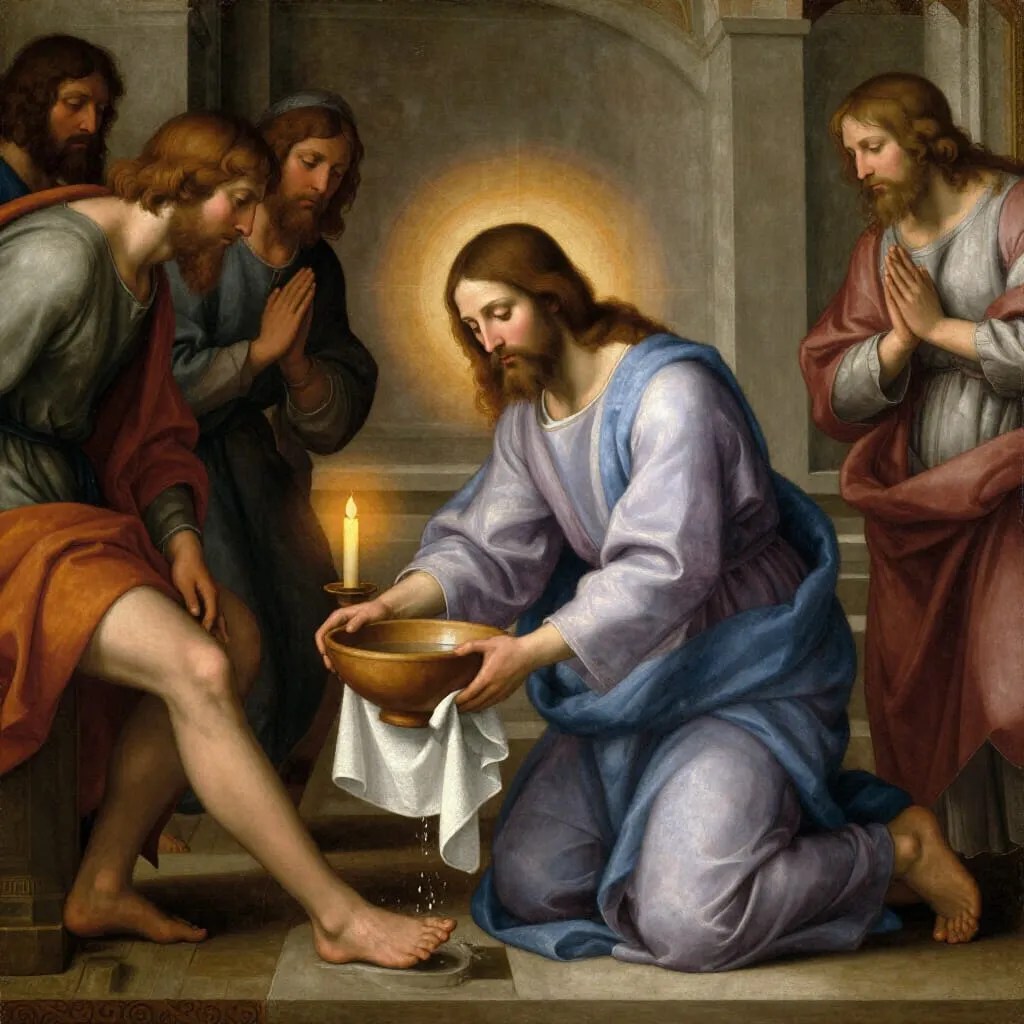
John 13 opens with the powerful scene of Jesus washing the disciples’ feet. This was an ordinary, even lowly, task, usually done by servants. But here, the one who came from God and was returning to God, kneels to wash dirty feet. John emphasises that Jesus does this because He is divine. It’s a profound picture of who God is: humble, serving, loving. Just as Jesus laid aside His garments to wash feet, He laid aside His glory to take on human nature and go to the cross.
This act also foreshadows the crucifixion. Jesus washing His disciples’ feet is an example of love and humility and a sign pointing to His death. The next time Jesus’ clothes are removed will be when He is crucified. Then, He will not just wash feet, but bear the sins of the world. Peter, characteristically outspoken, objects at first, but Jesus insists: ‘Unless I wash you, you have no part with me.’ This is not only about clean feet, it’s about spiritual cleansing. Jesus is saying: you must receive what I’ve come to give you, even if you don’t understand it yet. Then Jesus says something crucial in verse 15: ‘I have set you an example that you should do as I have done for you.’ Christians are called to serve, in small, humble ways, doing the dishes, taking out the rubbish, or staying late to help someone in need. True leadership in the kingdom looks like servanthood.
The Early Church Fathers who inspired the Celtic Church
John Cassian (c360–435) was a Christian monk and theologian
‘No structure of virtue can possibly be raised in our soul unless, first, the foundations of true humility are laid in our heart.’(2)
John Cassian played a crucial role in shaping Western monasticism. According to early Christian monastic tradition, Cassian recorded the teachings and practices he learned from the Desert Fathers, including Pachomius, in his written works. He visited Egyptian monastic communities: he travelled through Egypt around the late 4th century with his companion Germanus. They spent time among the desert monks of Scetis, Nitria, and Tabennisi, where they encountered disciples of Pachomius, the founder of cenobitic (communal) monasticism.
It’s impossible that Cassian met Pachomius himself, Pachomius died around 346, before Cassian’s time. Instead, Cassian learned from Pachomian monks who preserved their founder’s rules and sayings orally and in written form (in Coptic and Greek). Cassian carefully noted these teachings and observed how the Pachomian monasteries were organised. He later wrote two major works in Latin. First, De Institutis Coenobiorum (The Institutes of the Coenobia), which outlines the external practices and disciplines of monastic life. Second, Collationes Patrum (Conferences with the Fathers), which records the spiritual conversations he and Germanus had with the monks. These texts emphasised prayer, humility, obedience, and the spiritual combat against the eight principal vices (eg gluttony, pride, envy). Celtic monasticism was deeply shaped by these ideals, adopting and adapting Cassian’s spiritual disciplines in their own monastic communities. These books were written after Cassian settled in southern Gaul, drawing from the notes and memories of what he had seen and heard in Egypt. Cassian himself states that he wrote as faithfully as possible what he and Germanus heard, sometimes verbatim, sometimes summarised. He portrays the teachings in a dialogue form to preserve both the content and the spirit of the monks’ instruction.
The foot-washing episode in John 13:1–38 speaks powerfully to the importance of humility in Cassian’s writings. The Celtic Church, emerging as a vibrant monastic culture in the West, incorporated many of these Eastern ascetic principles, especially those related to inner prayer, solitude, and community life. Cassian’s works served as a bridge, making the spiritual riches of Eastern monasticism accessible to Western monks, including those in Celtic regions. His writings were practical guides for monks, addressing daily struggles in the monastic life. His emphasis on continuous prayer and vigilance influenced the Celtic ideal of constant communion with God.
John Mark Comer’s book Practicing the Way reminds us today of the importance of practices, habits and rhythms that the Early Church called a Rule of Life.(3) The Early Church fathers and Celtic saints saw practices like prayer, sabbath, solitude, fasting, community and Scripture as formative disciplines that shape our hearts, minds and bodies, and which help the believer grow in humility. Spiritual formation takes place as we rearrange daily rhythms, slow down, live intentionally, and become formed by Jesus rather than the cultural noise.
REVIVAL
As noted earlier, Roy Hession says that as we ‘find ourselves walking in a path of constant conviction and much humbling … we shall come into real conformity with the Lamb of God.’ (4) Curt Thompson says, ‘we think the becoming more like God means becoming more powerful and protected from pain, when in fact it is in suffering and in persevering in the face of it in vulnerable community that we actually become more and more like God.’(5)
PRAYER
This is the cross, this is the crown! You showed the way: to serve, to kneel, to love the ones who may not feel deserving grace. You showed the way.
Jesus washes Peter’s feet ( CLICK ON PICTURE TO LISTEN TO SONG)
______________________
(1) Wright, N.T. John for Everyone, Part 2, SPCK, (2002), 42-46
(3) Comer, J.M. Practising the Way, Form, (2024)
(4) Hession, R. The Calvary Road, Rockford Hill, (2003), 30.
(5) Thompson, C. The Deepest place and the formation of hope, Zondervan, (2023), 123.

 UNBLOCKING THE WELL OF THE LIVING WORD
Leave a comment