
John 19:1–16a
Focus verse: ‘We have no king but Caesar’ (John 19:15)
Old Testament lens: ‘The rulers gather against the Lord, against his anointed one’ (Psalm 2:2)
At the end of the film The Return of the King, Aragon, the newly-crowned king of Gondor, approaches the hobbits, and they bow in his presence. Aragorn lovingly corrects them and says, ‘My friends, you bow to no one.’ (1)
Here in John 19 the religious leaders say to Pilate, ‘We have no king but Caesar.’ The irony is devastating: the religious leaders, who should be waiting for God’s Messiah, pledge allegiance to a pagan emperor instead. In John’s Gospel the kingship of Jesus is not argued through theology or Scripture, but demonstrated in His obedience, His suffering, and His embodiment of truth.
As Roman governor, Pilate has the legal authority to release or execute Jesus. He even has the power to order the Jewish leaders to be silenced by force. So why doesn’t he do it? Pilate knows that if he lets Jesus go, the Jewish leaders could accuse him of letting a ‘rebel king’ slip through his hands. The threat of a bad report to Caesar becomes the trump card, which the chief priests play to manipulate Pilate. Once they say, ‘If you let this man go, you are no friend of Caesar,’ Pilate caves in. His desire to do the right thing is overridden by fear of political consequences.
But while Pilate appears powerful, Jesus is quietly exposing where true authority lies. He tells Pilate, ‘You would have no power over me if it were not given to you from above.’ Jesus is not denying Pilate’s authority, but He’s making it clear that even Rome’s power is under God’s control. Jesus doesn’t affirm Pilate’s actions, but He does affirm that God is sovereign, even in unjust situations. Then comes the most tragic moment: the chief priests declare, ‘We have no king but Caesar.’ This is shocking! For centuries, Israel’s identity was based on the belief that God alone is King, and one day the Messiah, God’s chosen King, would reign.
Pilate brings Jesus out and ‘sits on the judgment seat’. John may be subtly suggesting that Jesus, not Pilate, is the true judge in this scene. While Pilate appears to be judging Jesus, it is actually humanity that is being judged by how it responds to Christ. It’s noon on the Day of Preparation, when the Passover lambs were being slaughtered. This is no accident. Jesus is being presented not just as a king, but as the true Passover Lamb, whose blood will bring salvation.
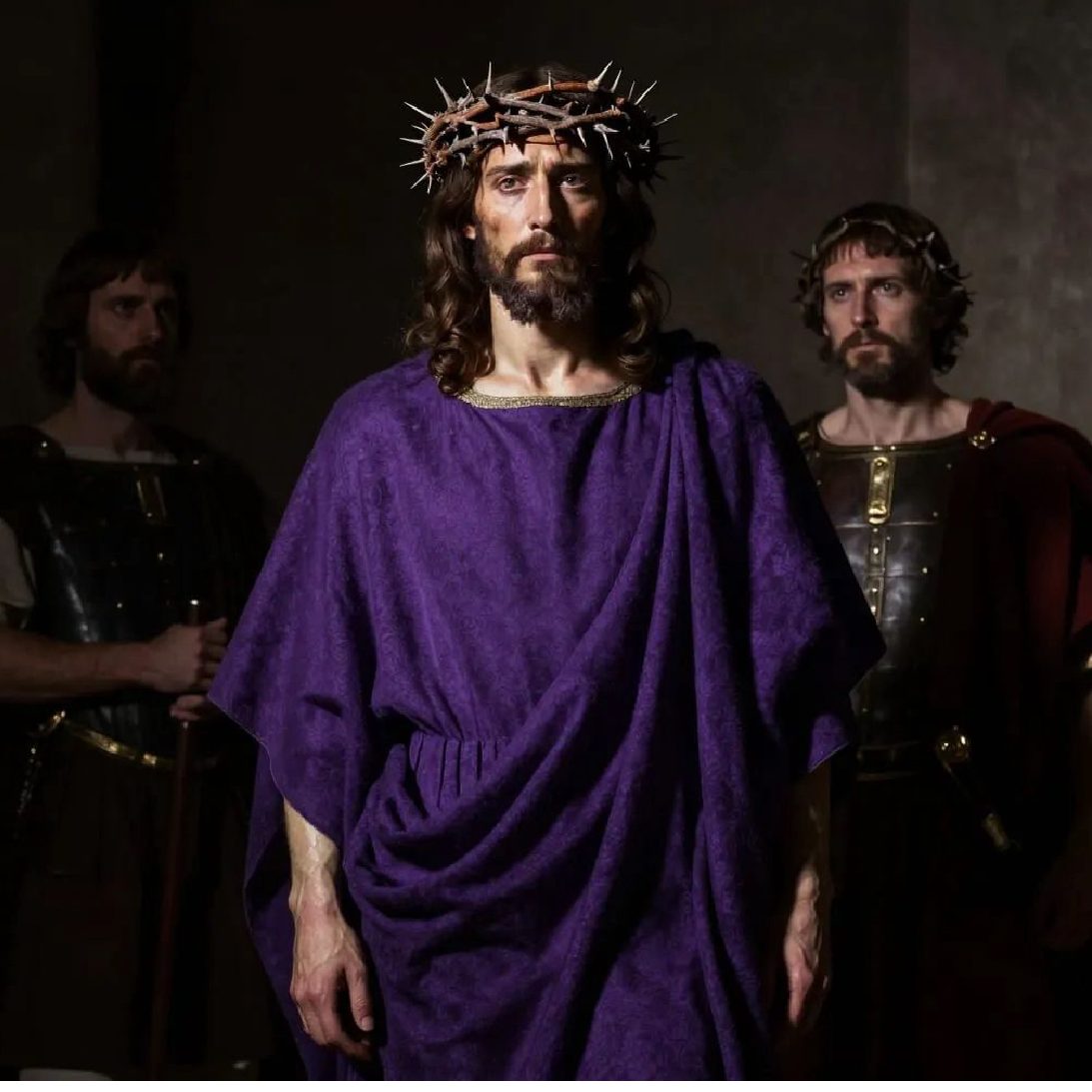
Pilate tries to mock both Jesus and the Jews by calling Jesus ‘your king’, dressed in a crown of thorns and a purple robe. Even Pilate’s mockery ends up declaring the truth. Like Caiaphas earlier in John’s Gospel, Pilate unknowingly speaks prophetic words: Jesus is King, and He must die for the people. The final judgment is not passed by Pilate but by the people who cry, ‘Crucify him!’ and by the chief priests who publicly reject God’s kingship. Pilate fails in his duty to uphold justice, and the Jewish leaders fail in their calling to be witnesses to God. Religious and political power structures are exposed and found wanting, but God’s purpose is being fulfilled.
Colossians 2:15 says, ‘The powers have been disarmed.’ The true King is not the emperor in Rome, nor the priest in the Temple, but the slain Lamb, Jesus.
The Early Church Fathers who inspired the Celtic Church
St Nicholas of Myra confronted Arius
‘Thou enemy of God, corrupter of the law, how dost thou dare look on us?’
St Nicholas intervened directly with a civil authority and said this to the Prefect (Eustathius) at Myra.(2) Nicholas was born and lived in Patara (Lycia, modern-day Turkey) around 270. He was orphaned young, and raised in a devout Christian family. His early acts of generosity (giving to the poor secretly) became legendary. He became Bishop of Myra, noted for his pastoral care, teaching, and moral courage. In Orthodox tradition, Nicholas is considered a model of holy leadership, combining charity with firm defence of orthodoxy. Nicholas of Myra is remembered as a bishop who feared God more than men, boldly confronting heresy and injustice, while embodying the love and charity of Christ.
The most famous episode connecting Nicholas to confrontation with authority involves Arianism. The issue was that Arius, a presbyter from Alexandria, claimed that Christ was a created being and not fully divine. Nicholas attended the First Council of Nicaea as Bishop of Myra. Tradition (though partly legendary) says Nicholas was so angered by Arius’ heresy that he physically struck Arius during the council. The council ultimately condemned Arianism and affirmed the full divinity of Christ, producing the Nicene Creed. Here Nicholas courageously confronted a heretical authority within the Church, standing for Christ’s truth. He is perhaps the earliest Orthodox saint whose courage in confronting authority, both spiritual and secular, parallels Christ’s moral courage in John 19 before Pilate.
St Aidan confronted King Oswald much like Jesus confronted Pilate in John 19:1–16. King Oswald was a devout Christian king, educated in Iona and deeply respectful of the monks. He even acted as Aidan’s translator, because Aidan spoke only Irish when he first arrived. This respect did not prevent Aidan from boldly correcting Oswald when necessary. On one occasion, King Oswald was giving a lavish gift, possibly gold or silver, to someone of importance. Aidan, observing this, rebuked him gently but firmly: ‘The son of a king should not give away what belongs to the poor, but rather what is his own.’ Aidan was criticising the misuse of royal wealth, which Jesus might call unjust stewardship, a subtle confrontation of how power is exercised.
Aidan’s rebuke was not angry, not dramatic, but quietly truthful, much like Jesus’ statements before Pilate. Aidan, like Jesus, lived with no fear of kings, because he served a higher King. Aidan’s correction of Oswald was not about humiliation, but transformation, calling the king to align his actions with the gospel, just as Jesus called Pilate to recognise the truth. In Celtic Christianity, spiritual authority was often seen as more powerful than royal or military strength. Aidan lived this, refusing wealth, giving away gifts to the poor, walking instead of riding, and staying close to the people. He lived simply, and corrected others from a place of deep love and humility, echoing Jesus’ non-violent, truth-speaking to corrupt power.
REVIVAL
Just as Jewish leaders rejected Jesus, they effectively rejected God’s kingship and handed themselves over to the rule of a pagan empire. If we are to see revival in Britain we need to see leaders with courage to stand up.
PRAYER
Lord, give me the courage to stand up and confront as Jesus did, as St Nicholas of Myra did, and as Aidan did. Give me the courage to stand up!
Behold the man! (CLICK ON THE PICTURE BELOW TO LISTEN TO SONG)
____________
(1) Return of the King, Film director Jackson, P(2003), Tolkien, JRR Lord of the Rings (1955)
(2) Michael the archimandrite, Life of St Nicolas.

 UNBLOCKING THE WELL OF THE LIVING WORD
Leave a comment